

Every enquiry. One clear next step.
Sales & CRM
When leads live in personal phones and reporting lives in spreadsheets, sales depends on memory. We give the team one pipeline the business can see and own.
This is one of the things a Custom Software build can include, so it is scoped and priced there rather than on its own. See Custom Software and what it costs
What it looks like
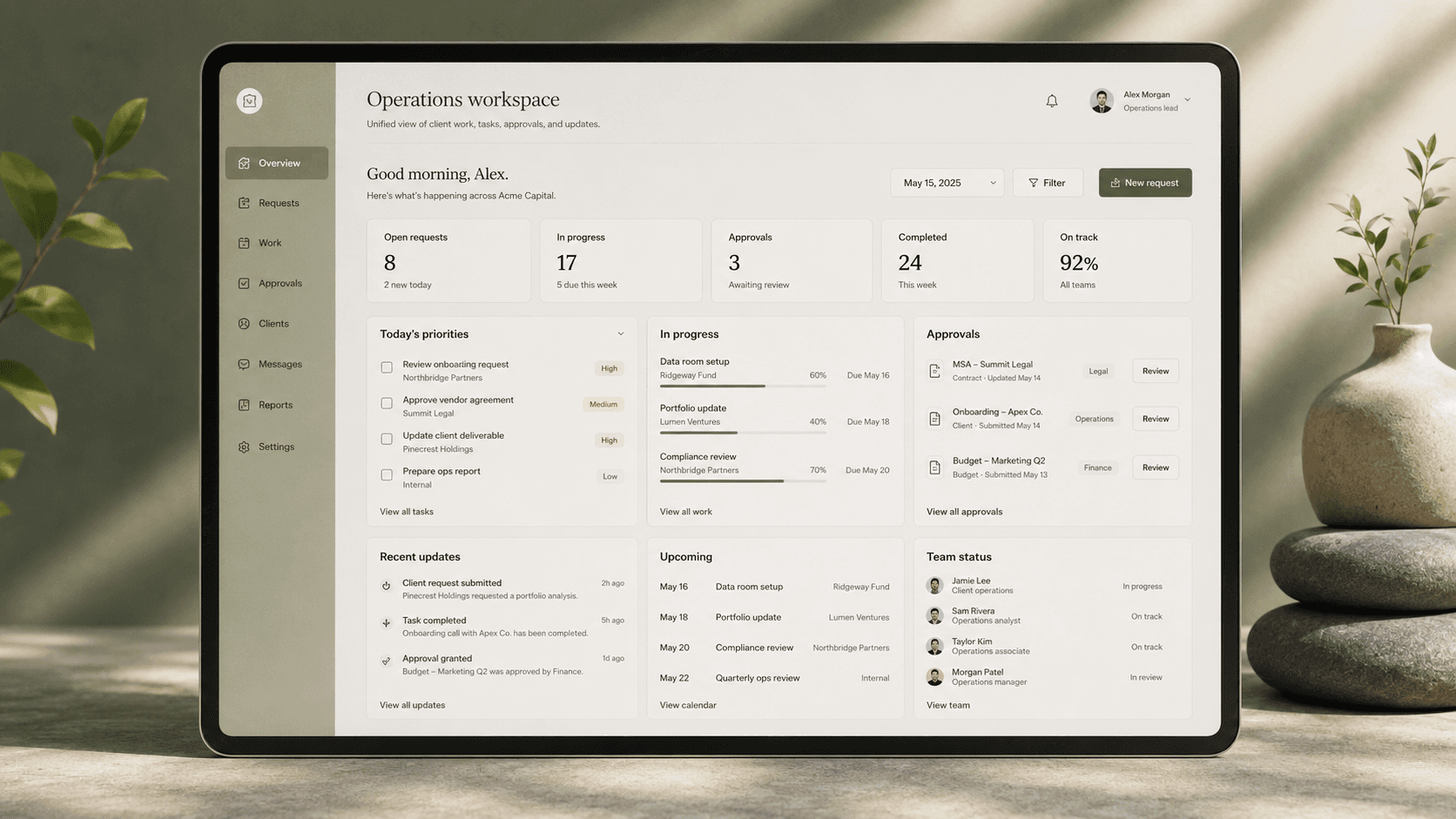
Right now, how many jobs are sitting between two people who each think the other has it?
Where things get stuck
- Work stalls in the handoff. Not inside a task, but between two people who both think the other one has it
- Nobody owns the date. A request with no name and no deadline gets delivered when someone remembers
- The boss is the tracker. Status lives in the owner's head and in the chats he scrolls back through
What gets built
- One owner per request. Every client request is assigned the moment it arrives, with a due date next to the name
- Approvals in the same place. What needs a sign-off waits in one queue, not in five chats
- Overdue shows itself. Anything past its date turns up at the top before the client calls about it
What you get back
- Nothing waits to be remembered. Every request carries a name and a date you can check
- Delivery dates stop being luck. Handoffs happen on the record, not by assumption
- You stop being the tracker. The status is on the screen, not in your head
Ideal for
SMEs with sales teams of 3 to 30 people who have outgrown spreadsheets but find off-the-shelf CRMs too rigid or too expensive at scale.
Might not be the right fit
Solo founders without a defined sales process, or teams that need a generic CRM running on day one. If your team is still figuring out how it sells, fix that first.
Work does not stall inside a task, it stalls between two people who both think the other has it. Count the handoffs in one job. Each one without a named owner and a deadline is a place your delivery date is decided by chance.
How a CRM build goes
01
Listen
We sit with your sales team. We see how leads come in, how they move, and where they fall through the cracks today.
02
Architect
We design the pipeline, stages, fields, and integrations before writing code. Walked through with you before build starts.
03
Build
The first phase usually ships in 4 to 8 weeks. You review working software throughout the build.
04
Evolve
After launch we stay close, fix what needs fixing, and ship the next piece once the first is stable.
FAQ
FAQ
Yes. Spreadsheets, Google Sheets, HubSpot, Pipedrive, and the regional CRMs are all routine. We move it to a test environment first, so you see it land before it goes live.
They will have been using it for two or three weeks before launch day, because we train during the build, not after. A CRM nobody opens is the most common way this money gets wasted, so we design for the salesperson first and the report second.
It changes with you. The system is yours, so you can change it yourself, or we do it as a change request.
Which of these sounds like your business?
Same work, different companies. Open the one you recognise and see what it takes to remove it.
Process Automation
The routine work should run without chasing.
Sign you'd want this
Approvals wait for someone to notice a WhatsApp message
Practical AI
Give AI one useful job.
Sign you'd want this
Your staff spend hours reading documents just to pull out a few numbers
WhatsApp Automation
Every enquiry gets a clear next step.
Sign you'd want this
Enquiries arrive on WhatsApp and get answered whenever somebody happens to look
Which part of this is your problem?
Two or three sentences is enough. We will tell you what the first useful phase looks like before you commit to a build.